
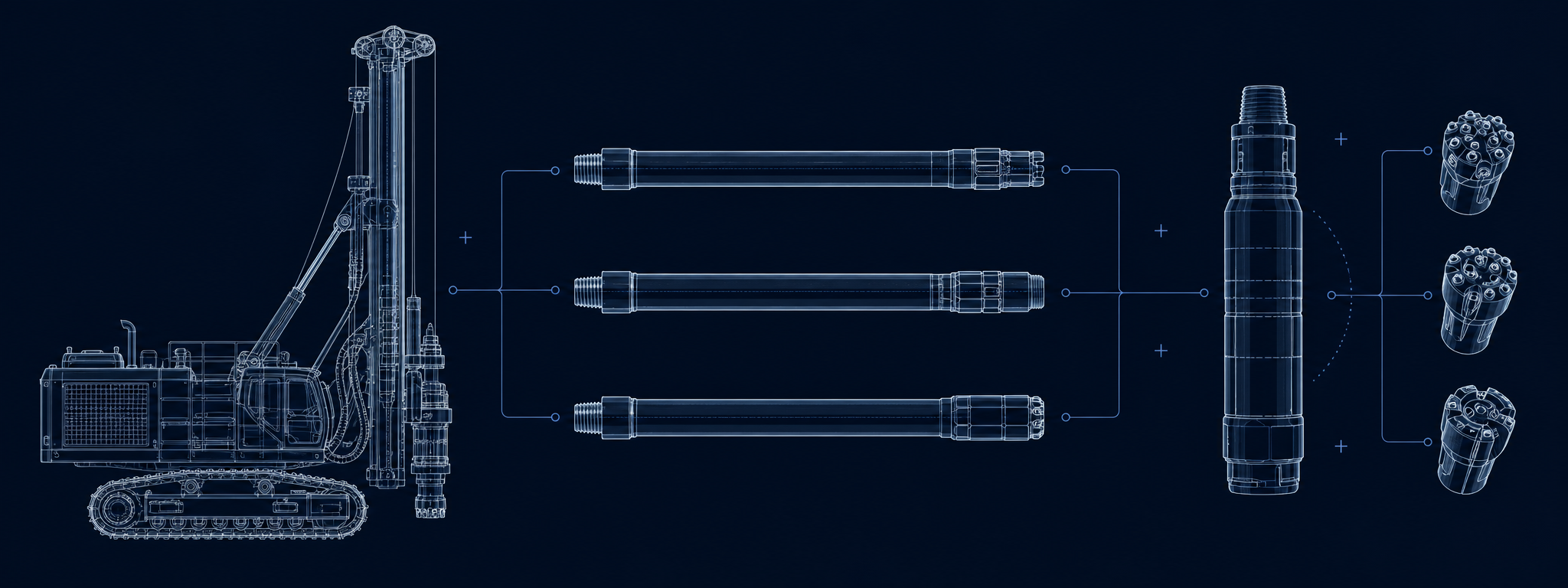
Short answer: Select water well drill pipe by matching the rig’s rotary head and clamps, the hammer or bit connection, target depth, bore diameter, compressor airflow, torque and pullback, pipe-handling length, thread form, wall thickness, and steel grade. Do not select by outside diameter alone. Confirm every pin/box interface and obtain a dimensional and inspection schedule before ordering.
Drill pipe is the mechanical and fluid connection between the rig and the cutting tool. It transmits rotation, feed and pullback while carrying compressed air or drilling fluid. A mismatch can reduce hole cleaning, damage threads, overload the rotary head, slow rod handling, or leave a tool string that cannot be assembled at the job site.
This guide focuses on DTH and threaded water-well drill pipe for equipment buyers, drilling contractors, distributors, and service teams. It explains how to create a reliable selection and RFQ specification without assuming that every pipe of the same nominal size is interchangeable.
The Seven Checks at a Glance
| Check | Question to answer | Common purchasing error |
|---|---|---|
| 1. Application | What formation, method, depth and finished hole are planned? | Ordering from a generic size list |
| 2. Diameter and wall | Will the pipe carry the load and leave enough annulus for returns? | Choosing the largest OD without checking airflow or handling |
| 3. Thread | What exact connection is required at every interface? | Treating REG, NC or similar names as interchangeable |
| 4. Length | What length fits mast travel, handling, transport and production goals? | Buying long pipe that the rig cannot load or clamp safely |
| 5. Material | What steel grade, tool-joint material and manufacturing route are specified? | Assuming a grade name alone defines finished-pipe quality |
| 6. Operating loads | What torque, feed, pullback, pressure and fatigue cycles are expected? | Checking static dimensions but not operating limits |
| 7. Inspection | How will dimensions, threads, welds, straightness and packing be verified? | Accepting “inspected” without agreed records or criteria |
1. Begin With the Drilling Application
Before selecting pipe, define the drilling method and the complete bore program:
- expected formation by depth;
- typical and maximum hole depth;
- pilot and final bore diameter;
- DTH hammer or rotary bit type and size;
- compressor pressure and free-air delivery, or mud-pump duty;
- casing program and any casing-advancement system;
- rig rotary torque/speed, feed, pullback, clamps and mast travel;
- transport limits and manual or mechanical rod handling;
- expected wells or operating hours per month.
For DTH drilling, the pipe must deliver air to the hammer while transmitting rotation, feed and recovery loads. In mud rotary, the internal passage, connections and pressure rating must support drilling-fluid circulation. The selection logic overlaps, but the wear, sealing, flow and handling priorities may differ.
If you already own the rig and hammer, photograph their connections and record dimensions. If the equipment is being purchased as a package, require one supplier or system integrator to provide an interface matrix.
2. Select Outside Diameter and Wall Thickness Together
Outside diameter affects stiffness, strength, weight, annular area, clamp range, and compatibility with the hammer and bit. Wall thickness affects internal flow area, mass, resistance to load and wear, and connection/manufacturing design. Neither value should be changed independently without checking the system.
Why the annulus matters
In DTH drilling, cuttings return through the annular space between the pipe OD and bore wall. A smaller annulus can increase return velocity for a given airflow, but the correct value depends on cuttings size, leakage, depth, water influx, and pressure losses. A very large bore around a small pipe may require more airflow for effective cleaning. A larger pipe reduces annular area but may increase weight and compressor-flow losses through a different internal diameter.
This is why “use the biggest pipe” and “use the smallest pipe” are both poor universal rules. Ask for a calculation or documented matching basis using the actual bit diameter, pipe OD/ID, depth, hammer consumption, and compressor output.
Catalog ranges are not automatic combinations
The supplied DTH water-well drill-pipe catalog includes examples at 76, 89, 102, 114, and 127 mm OD. It lists different wall thicknesses, lengths, thread options, and steel grades by size. These rows show available families to investigate; they do not mean that every thread, grade, length, and wall can be freely combined.
For example, the catalog associates 76 mm pipe with a 2 3/8 REG connection in one configuration, while 89 mm entries include 2 3/8 REG and NC26 options. Larger sizes include other REG and NC options. The quotation and approved drawing must state the exact combination.
3. Confirm the Exact Thread and Shoulder
Thread mismatch is one of the highest-risk purchasing errors because a connection may appear close enough to start but fail to seat correctly. Forced makeup can damage threads, create leakage, concentrate stress, or make breakout impossible.
Record for every interface:
- thread designation and governing drawing or standard;
- pin or box orientation;
- nominal size and pitch/form;
- shoulder and seal arrangement;
- makeup torque or procedure;
- wrench-flat position and dimension;
- required adapter or sub;
- acceptable thread-gauge and inspection record.
Do not describe an order only as “API thread.” API-related thread families include different connections. REG, NC, IF, FH and other designations are not interchangeable merely because their nominal sizes look similar. The drill-pipe connection also has to match the top sub, rotary head, hammer backhead, bit sub, or casing tool on the correct end.
Use an interface matrix
| Component | Connection on component | Mating component | Required adapter/sub | Confirmed by |
|---|---|---|---|---|
| Rotary head | Exact pin/box and drawing | Top sub | Part number and drawing | Rig supplier |
| Top sub | Upper and lower connections | First drill pipe | Part number and drawing | System supplier |
| Drill pipe | Pin/box thread | Next pipe | None if identical | Pipe supplier |
| Bottom pipe | Pipe thread | Hammer/bit sub | Part number and drawing | Tool supplier |
| DTH hammer | Backhead connection | Bottom sub/pipe | Part number and drawing | Hammer supplier |
Attach photographs and measured reference dimensions when matching older equipment. A photo alone is not a dimensional specification, but it helps identify what needs to be measured.
4. Choose Length for Mast, Handling, and Logistics
Longer pipe reduces the number of connections for a given depth, which can reduce handling cycles. It also increases individual-piece weight, transport length, storage needs, mast requirements, and handling risk. Shorter pipe is easier to handle on compact sites but requires more connections and makeup/breakout cycles.
Confirm:
- usable mast feed travel and maximum pipe length;
- clearance for loading and removing pipe;
- clamp and breakout position;
- manual handling limit or rod-loader capacity;
- pipe weight per piece;
- truck, container, rack and site-storage dimensions;
- whether casing and pipe can be handled without interference.
The supplied catalog includes length examples from 1 to 6 m depending on pipe size and configuration. One illustrated crawler rig lists 1.5, 2.0 and 3.0 m pipe compatibility. These are catalog examples; the approved rig-pipe combination must be reconfirmed before purchase.
5. Specify Steel Grade, Tool Joint, and Manufacturing Route
Steel grade matters, but it is not the entire quality specification. Finished-pipe performance also depends on body dimensions, tool-joint material and geometry, heat treatment, welding or friction-welding process where applicable, thread machining, stress concentration, straightness, surface condition, and quality control.
The supplied catalogs list DTH pipe configurations using grades such as R780, G105, and S135, and other drill-pipe families with E75, G105 and S135. Tool-joint or adapter materials shown elsewhere include alloy-steel designations such as 35CrMo, 42CrMo, and 4137H. These names should be treated as product-specific catalog references, not proof that any material is appropriate for every water-well application.
Ask the supplier to state:
- pipe-body grade and applicable material specification;
- tool-joint or end material;
- heat-treatment condition;
- manufacturing and joining method;
- hardness range where relevant;
- traceability marking;
- inspection standard and acceptance criteria;
- certificate type included with the shipment.
If a project requires API Spec 5DP or another standard, put the exact edition, product specification level or additional requirement in the purchase document after technical review. Do not infer compliance from a thread name or grade alone.
6. Check Operating Loads and Air or Fluid Performance
Torque and makeup
The rig’s available rotary torque must not exceed what the selected connection and pipe can safely accept under the planned procedure. At the same time, connections need correct makeup to resist loosening and leakage. Obtain manufacturer guidance for makeup, thread compound, inspection, and retirement. Avoid using the rig’s full breakout force as a substitute for controlled connection practice.
Feed, pullback, and string weight
The pipe carries compressive and tensile loads during drilling and recovery. Evaluate total string weight, hammer/bit weight, friction, water or fluid effects, stuck-tool contingency, and dynamic loading. Rig pullback capacity is not the pipe’s allowable tensile load, and neither should be used without an operating margin and engineering review.
Bending and fatigue
Misalignment, rapid formation changes, excessive feed, worn centralization, and hole deviation add bending. Threads and transition zones experience repeated cycles as pipe is made up, drilled, pulled, and broken out. Straightness, correct handling, smooth controls, and timely rejection of damaged pipe are part of fatigue management.
Internal flow and pressure loss
For DTH, compare the pipe’s internal flow area and connection restrictions with hammer airflow. Pressure available at the compressor is not identical to pressure delivered at the hammer. Hoses, fittings, rotary head, pipe length, adapters, leakage, elevation and water all create losses.
For mud rotary, check internal diameter, joint restrictions, pump curve, fluid properties, depth, and pressure rating. The supplier should identify the weakest pressure-rated component in the circulation path.
7. Agree on Inspection Before Production and Shipment
An effective inspection plan is specific, traceable, and appropriate to the order. It does not need to reveal proprietary manufacturing details, but it should show that the delivered pipe matches the approved specification.
Dimensional checks
- outside diameter and wall thickness or inside diameter;
- overall length and upset/joint dimensions;
- straightness;
- thread and shoulder dimensions using suitable gauges;
- wrench-flat geometry and clamp compatibility;
- pin/box orientation and adapter dimensions.
Material and manufacturing records
- heat or batch traceability where specified;
- material certificate required by the purchase order;
- heat-treatment record or certificate where applicable;
- weld or friction-weld inspection for the selected construction;
- hardness or mechanical test records when included in the agreed plan;
- non-destructive testing method and acceptance criteria when specified.
Visual and functional checks
- thread finish, shoulder condition, burrs, dents, cracks or corrosion;
- internal cleanliness and unobstructed air/fluid passage;
- correct markings and piece count;
- trial makeup with an approved gauge or mating component where appropriate;
- thread protectors, corrosion protection, bundling, lifting points and packing list.
The supplied catalog shows inspection equipment and states that products are checked before delivery. Buyers should still put the required records, sampling level, acceptance criteria, and witness points in the order. A general quality statement is not the same as an order-specific inspection report.
Build a Complete RFQ Specification
Use this checklist when requesting a drill-pipe quotation.
| RFQ field | Example of the required level of detail |
|---|---|
| Application | Water well DTH drilling; expected formation by layer |
| Hole program | Typical/max depth; bit and final bore diameter; casing plan |
| Rig | Model, rotary-head connection, torque/speed, pullback, clamp range, mast travel |
| Hammer/bit | Brand/model or exact backhead thread and bit shank/diameter |
| Compressor/pump | Working pressure, FAD or pump duty, connection size |
| Pipe body | Required OD, wall/ID, length, grade and construction |
| Connections | Exact pin/box designation, drawing, shoulder and makeup guidance |
| Adapters | Top sub, bottom sub, crossover and spare quantities |
| Quantity | Working string, reserve percentage and replacement strategy |
| Inspection | Dimensions, gauges, certificates, NDT/test scope, traceability |
| Packing | Thread protectors, bundle weight, rack/crate, corrosion protection |
| Documents | Approved drawing, packing list, inspection report, manuals/care guide |
Request a controlled technical drawing before final approval. If the drawing and quotation conflict, resolve the discrepancy in writing and issue a revised document.
Common Drill-Pipe Selection Mistakes
Buying by OD only
The OD may fit the clamp while the thread, wall, air passage, length, grade, or hammer interface does not. Specify the complete configuration.
Mixing similar-looking threads
Never force a connection or modify threads at the job site to “make them fit.” Isolate mismatched components, identify both threads, and use an engineered crossover where suitable.
Ignoring pipe weight
Calculate per-piece and total string weight. Confirm rod-loader or manual handling, mast travel, pullback, rack capacity, and shipping bundle limits.
Ordering no spare adapters
The crossover or top sub may be a single point of failure. Where the application permits, include a defined spare quantity and protect it from corrosion and impact.
Treating maximum rig torque as normal connection torque
Full machine torque can damage threads or make breakout difficult. Follow pipe/tool manufacturer guidance and use suitable thread compound, cleaning, inspection, and controlled makeup.
Failing to inspect after hard service
Retire or quarantine pipe with cracked or deformed connections, severe wear, bending, deep corrosion, damaged shoulders, or repeated leakage. Establish site inspection intervals based on duty and manufacturer guidance.
Shipment Inspection and Site Preparation
Before loading, count every pipe and adapter, verify markings against the packing list, photograph thread condition, confirm protectors, and inspect bundles and lifting provisions. Prevent steel bands or supports from damaging finished surfaces. Separate adapters and small parts into identified protected boxes.
At the site, prepare level racks that keep pipe out of soil and standing water. Provide thread-cleaning tools, approved compound, protectors, handling tools, and a rejection area. Train operators to align connections before makeup and to avoid dragging threads. Record the initial pipe inventory and identify each rejected or repaired component.
During the first bore, monitor makeup/breakout behavior, leakage, vibration, return quality, penetration changes, and thread temperature or visible distress. Stop and investigate repeated loosening or leakage; increasing torque without finding the cause can worsen damage.
Frequently Asked Questions
What drill-pipe size is used for water well drilling rigs?
There is no single standard size for all rigs and wells. DTH water-well pipe catalogs commonly include multiple ODs; the supplied catalog includes 76, 89, 102, 114, and 127 mm examples. The correct size depends on rig clamps and rotary head, hammer, bit diameter, depth, compressor airflow, loads, and handling.
Is 76 mm or 89 mm drill pipe better?
Neither is universally better. Compare required thread, wall/ID, depth, pipe weight, annular area, compressor and hammer, rig torque/pullback, clamp range, and mast. A supplier should explain the complete match for the proposed bore.
Can I connect REG pipe to an NC thread?
Not directly unless the exact connections are designed to mate—which generally should not be assumed. Identify both threads from controlled drawings or gauges and use a correctly engineered crossover sub if the system permits.
Does higher steel grade always mean longer life?
No. Grade is only one factor. Geometry, heat treatment, manufacturing quality, thread condition, welding, bending, corrosion, operating loads, handling, and inspection practice also affect service life. Select the grade within an engineered pipe configuration.
How many spare drill pipes should I order?
The quantity depends on depth, number of active rigs, utilization, site remoteness, expected wear, damage history, and replenishment lead time. Separate the working string, contingency reserve, and critical adapters in the spare-parts plan rather than applying one arbitrary percentage.
What should be included in a drill-pipe inspection report?
Include order and batch identification, quantities, key dimensions, thread/gauge results, straightness, visual findings, required material/test certificates, non-destructive testing results if specified, marking, and packing condition. The scope should match the purchase specification.
How can I identify an unknown thread on existing equipment?
Clean the connection, determine pin or box, measure major/minor diameters where appropriate, pitch, taper, thread form, shoulder and length, and compare with controlled drawings or gauges. Send clear photographs with a scale, but do not rely on a photo alone for final manufacture.
Conclusion
Reliable drill-pipe selection is an interface-management task. Start with the hole and method, then verify OD and wall, exact thread, length, material and manufacturing route, operating loads, internal flow, rig and hammer compatibility, inspection records, and field handling. Every choice affects another part of the drill string.
A controlled interface matrix and approved drawing cost very little compared with a shipment of incompatible pipe. Make them mandatory before production.
Technical Sources and Scope
General DTH operating principles were cross-checked against Epiroc’s DTH hammer instructions. The API publications catalog describes the scope of API Spec 5DP. Product examples and size/thread/grade combinations come from the supplied Tongshun drill-pipe catalog; the approved drawing and purchase specification remain controlling.


